28 April 2026
Czech animation foregrounds children’s and youth storytelling
Czech animation foregrounds children’s and youth storytelling

Czech animation arrives at the 50th edition of the Annecy International Animation Film Festival with a focused slate that underscores the country’s growing strength in children’s and youth-oriented storytelling. Across feature, short and television formats, the selected films demonstrate a capacity to deliver visually distinctive, internationally legible films and series.
by Martin Kudláč for CZECH FILM / Summer 2026
Following a string of strong showings in recent years, Czech animation returns to the Annecy IAFF, which is celebrating its 50th anniversary, with further evidence of a sector that remains both artistically fertile and structurally diverse. This year’s selection points to several defining qualities: the steady emergence of new talent, alongside the continued importance of film-school and television-backed production.
The Czech presence at Annecy 2026 is less about presenting a unified aesthetic front than about mapping the breadth of a scene in active development. The selected works move across registers, techniques and intended audiences, combining artisanal visual sensibilities with a marked readiness to experiment in form, tone and narrative scale.
Tactile worlds and restless imaginations
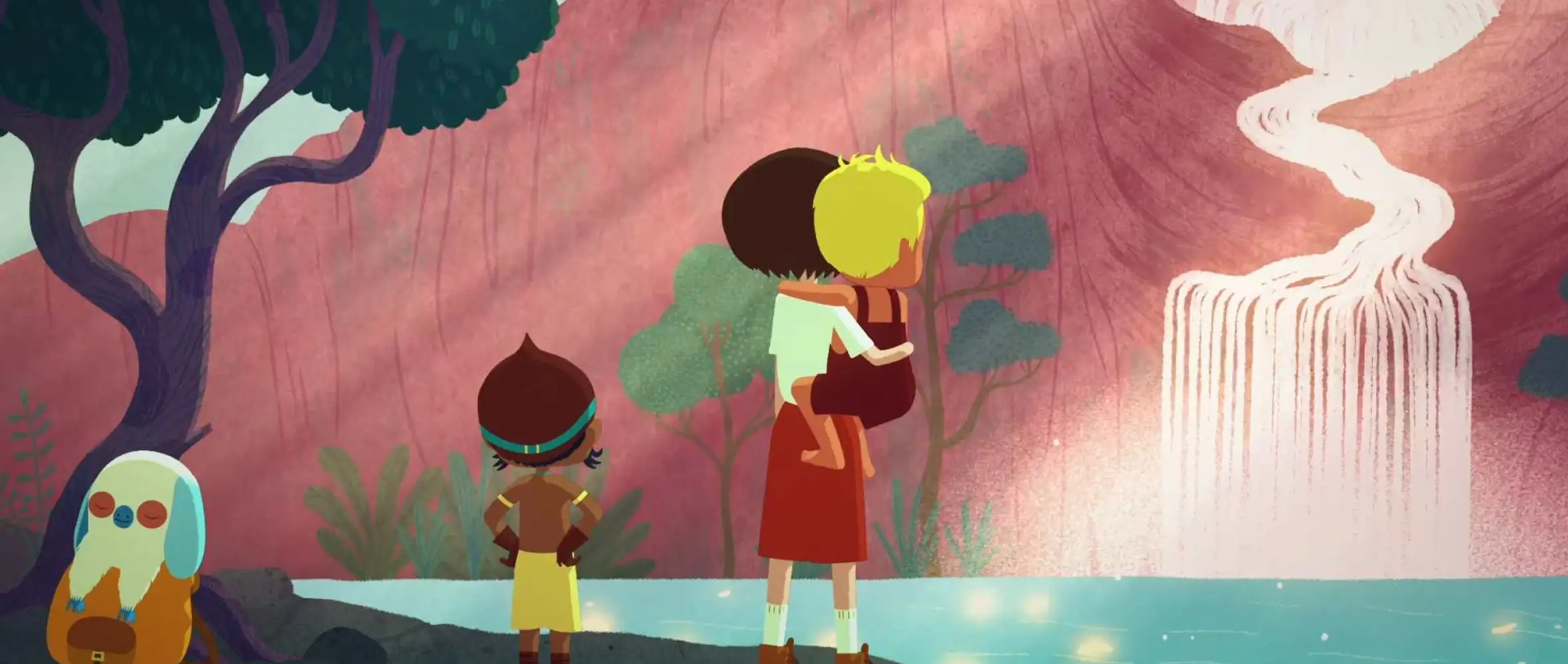
The family adventure Born in the Jungle directed by Edmunds Jansons and coproduced by Czech producer Vladimír Lhoták of Hausboot, is inspired by the real-life story of Latvian-born explorer Aleksandrs Laime and his family. Set in late-1950s Venezuela, the film follows nine-year-old Elisabeth, whose search for her missing brother leads her deep into the rainforest and toward a mythical creature she must help return to the towering Tepui mountain. The story unfolds across a vividly stylised natural world, lush riverbanks, expansive savannahs and vertical landscapes punctuated by waterfalls, where moments of quiet observation alternate with episodes of adventure and discovery. The visual language, shaped by Latvian illustrator Elīna Brasliņa, combines cut-out animation with 2D digital techniques, resulting in a flattened yet textured aesthetic built on colour blocks, soft gradients and expressive character design.
Born in the Jungle, selected for Annecy Presents, is produced by Latvia’s Atom Art in coproduction with Poland’s Letko and the Czech company Hausboot, with additional creative input from France, Portugal and Chile. While the film’s creative direction is anchored in Latvia, the Czech contribution is substantial: parts of the animation were carried out in the Czech Republic, the score was recorded in Prague, and the film’s sound post-production was also handled on the Czech side. Backed by Creative Europe MEDIA, the Czech Audiovisual Fund, the National Film Centre of Latvia, the Polish Film Institute and Eurimages, the film has also secured a broad slate of presales ahead of its world premiere, including France, Germany, Spain and Sweden, among others. The international sales is handled by Dandeloo.
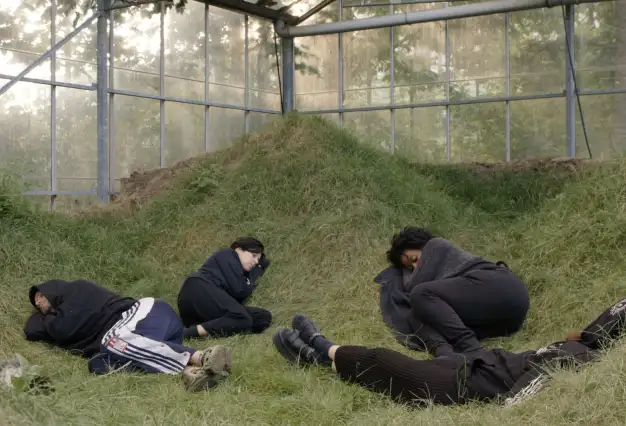
A similar logic of international collaboration extends into short-form production in Please, the latest short by Swedish animator Anna Mantzaris, coproduced on the Czech side by Radim Procházka of Kuli Film and selected for the Short Film Competition. Conceived as a series of loosely connected episodes exploring emotional fragility and unmet desire in urban life, the film continues Mantzaris’s interest in exposing the dissonance between social behaviour and inner impulse. The Czech contribution is embedded across key areas of production: costume design for the puppets was led by Anna Gutová, while Prague-based studios Anima and Atelier 22 handled the fabrication of sets and props. A significant portion of the animation was carried out by Marek Jasaň and Jiří Krupička, working alongside a local crew under cinematographer Jakub Halousek.
If both Born in the Jungle and Please foreground Czech animation’s integration into international production pipelines, Wildbait by Lee Oz and Eliška Oz, selected in the TV and Commissioned Films section, points in a different, though no less telling, direction. Produced as a music video for Taiwanese artist Oberka, the short embraces an unrestrained aesthetic, unfolding within a grotesque clay-crafted universe where narrative coherence gives way to associative, often absurd imagery and anarchic energy.
From FAMU to Annecy
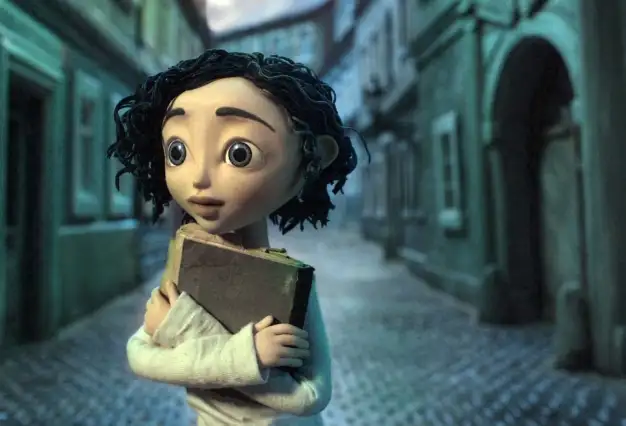
Alongside its international production footprint, Czech animation continues to assert itself as a medium of intimate, experience-driven storytelling, sustained in large part by the country’s film-school infrastructure. Annecy once again highlights the enduring role of FAMU as a space where formal experimentation and personal expression converge. Jamaica Kindlová’s Gently, selected for the Graduation Films Competition, exemplifies this trajectory. Produced by FAMU in coproduction with BATCH film and the FILMTALENT Zlín Foundation, the short draws on real childhood memories to depict a seemingly ordinary upbringing gradually shaped by tension and latent threat.
Kindlová’s use of hand-drawn charcoal animation is central to this approach. Grainy textures, blurred edges and shifting contours translate the child’s embodied perception into visual form. Interiors are reduced to sparse, almost abstract environments, a flickering television, a hand gripping a cup, a figure hesitating in a doorway, constructing a psychological landscape where safety is provisional. At the same time, Gently reflects a generational shift in thematic focus. Where earlier Czech animation often relied on allegory or abstraction, the film engages more directly with experience, grounding its emotional register in recognisable social realities while maintaining formal stylisation.
Čapek’s legacy and mythic playgrounds
If one strand of Czech animation continues to evolve through personal, introspective work, another remains anchored in its long-standing relationship with children’s storytelling.
Andrea Szelesová’s Eeny, Meeny, Miny, Moe!, selected in Annecy’s Young Audiences competition, exemplifies a current tendency toward visually sophisticated, internationally legible storytelling for younger viewers. The short film, which premiered in the Generation Kplus Shorts Competition at the Berlin International Film Festival, is produced by Pure Shore in coproduction with Czech Cinepoint and Slovak ansze, with support from the Czech Audiovisual Fund, Creative Europe MEDIA and FILMTALENT Zlín. Framed as a myth-inspired coming-of-age tale, it unfolds in a stylised universe set in a playground among the clouds, inhabited by children of gods and monsters.
Drawing on ancient iconography, Minoan frescoes, decorative ceramics and archaic ornamentation, the dialogue-free film adopts a playful hand-drawn 2D aesthetic populated by hybrid figures and symbolic forms. At its centre is Yios, a boy marked by a volatile “sun-crown” he cannot control. What begins as a fable of exclusion gradually shifts toward acceptance, reframing difference as a condition to be understood rather than suppressed.
A complementary approach is embodied in Doggie and Pussycat, directed by Barbora Dlouhá and selected in Annecy’s TV and Commissioned Films competition. Produced by the Czech Television, the series revisits the canonical stories of Josef Čapek, translating their distinctive visual and storytelling sensibility into a contemporary animated form. The adaptation balances fidelity to the original material with a softened, modernised aesthetic, retaining the simplicity and poetic naivety of Čapek’s drawings. Rather than offering a revisionist take on a familiar property, the series preserves its narrative and visual recognisability while reshaping the material for present-day serial viewing.