


24 April 2026
Handcrafted animation and the inner worlds of childhood
Kristina Dufková and Filip Pošivač
Handcrafted animation and the inner worlds of childhood
Kristina Dufková and Filip Pošivač

Kristina Dufková and Filip Pošivač occupy distinct yet intersecting positions in contemporary Czech animation, sharing an interest in material, handcrafted aesthetics and a sustained focus on childhood as a site of emotional formation. Drawing on the country’s puppetry tradition, both use tactile worlds to externalize inner experience shaped by isolation, difference, and the search for belonging, while diverging in their generational context and visual approaches. Together, they outline a field in transition, where continuity of craft intersects with formal and industrial transformation.
by Martin Kudláč for CZECH FILM / Summer 2026
Kristina Dufková: Puppetry and the emotional realities of growing up
Director, animator, and artist Kristina Dufková, a graduate of FAMU’s Animation Department, creates emotionally accessible animated films for children and adolescents, using stylized, handcrafted worlds to explore vulnerability, difference, self-acceptance, and the complexities of growing up, while steering clear of overt moralizing.
Dufková first drew attention with her graduation film, A Tear Is Needed (2008), a hand-drawn animated short, which earned her the honor of Best Czech Animated Film at AniFest, the international animation festival held annually in the Czech Republic. Inspired by an old Mexican legend, A Tear Is Needed, which Dufková describes as “horror for children,” follows a young protagonist into the realm of the dead, combining surrealist playfulness with an exploration of death and emotional perception. The project was later adapted into both a book and a stage play.
Over the following decade, Dufková worked across formats and techniques. She contributed to the omnibus feature Fimfárum: To Third Time Lucky (2011), directing the segment How Giants Vanished from Šumava, while further developing her voice through the television projects Tales of Mum and Dad and Don’t Call Me Panda, My Name Is Fanda. These works foregrounded themes rarely encountered in children’s animation—speech disorders, family tensions, and bodily difference—employing visual wit rather than a didactic approach.
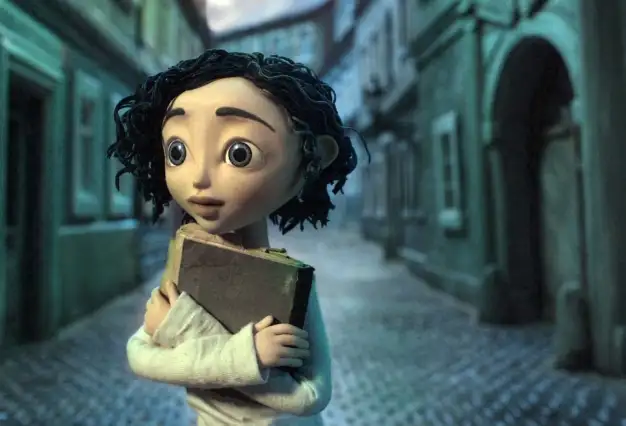
Dufková’s first standalone feature—Living Large (2024), produced by Barletta as a Czech-Slovak-French coproduction—marked a shift toward older children and teenage audiences. Premiering in the Contrechamp section at the Annecy International Animation Film Festival, where it received the Jury Award, the film then went on to Karlovy Vary and later won the Czech Lion and the ECFA Award for Best European Children’s Film, as well as a European Film Awards nomination. Based on Mikael Ollivier’s bestselling novel of the same name, Living Large is a tactile coming-of-age story about an overweight teenage boy navigating first love and self-image. Combining expressive stop-motion puppetry with painterly 2D animation, it turns physicality into emotional language, blending humor, exaggeration, and subjective fantasy into an intimate portrait of adolescence. International sales by Goodfellas secured distribution across Europe, Japan, and the Middle East, supporting a wide festival-driven rollout.
Dufková is now entering a new production phase with projects that broaden both her thematic scope and technical approach. Her next feature, the family adventure puppet film Wish It, is in production at Barletta as a Czech-Slovak-Polish-French coproduction involving Barletta, Novinski, Foliascope, and WJTeam/Likaon, with support from the Czech State Audiovisual Fund, the Slovak Audiovisual Fund, Creative Europe MEDIA, and Czech Television. International sales are handled by Goodfellas.
Cowritten with Tomáš Holeček, Wish It follows two children, Albína and Vojta, whose wishes come true in unexpected ways: a runaway snake becomes an unlikely pet, while a lost elderly woman offers Vojta a chance at experiencing the family he always longed for. The story unfolds into an adventure about loneliness, difference, prejudice, friendship, and the force of belief, aimed primarily at younger audiences. Conceived as a classical stop-motion film, Wish It branches out from Dufková’s handcrafted approach to employ more mobile camerawork, expressive puppet design, selective use of color 3D printing and AI-assisted postproduction, and a visual concept built around symbolic color dramaturgy, shifting perspectives, and a musical chorus of lice. Production is slated to run from 2026 to 2028, with completion targeted for 2029.
In parallel with Wish It, Dufková is also developing The Bone, a feature adaptation of the Magnesia Litera-winning novel of the same name by Bára Dočkalová. Aimed at children aged 10 and up, it follows a boy who steals a bone from a countryside grave, setting off a chain of events that lead him to confront both local traditions and his own family history. In contrast to Dufková’s previous work, the project displays a darker, subtly horror-inflected register, combining advanced fabrication techniques, including color 3D printing, with an emphasis on atmosphere, material texture, and in-camera stylization. Production is expected to follow Wish It, with a projected start in 2028 or 2029.
Also in the works for Dufková, beyond features, is a stop-motion series for very young audiences, conceived as a short-form, dialogue-light format with simplified puppet design and clear international ambitions. With her wide range and prolific creativity, Dufková is a major contributor to the renewed international visibility of Czech animation, stretching its tradition of material craftsmanship to include more psychologically nuanced and globally accessible narratives for children and adolescents.
Filip Pošivač: Animating childhood through puppetry and imagination
Director and illustrator Filip Pošivač, a graduate of Prague’s Academy of Arts, Architecture and Design (UMPRUM), emerged as a major new voice in European animation with his debut, Tony, Shelly and the Magic Light (2023), which earned him a Czech Lion and a Slovak Sun in the Net award, as well as the Jury Prize at Annecy. His work lies at the intersection of illustration and animation, creating emotionally grounded stories for children that use material, handcrafted worlds to explore questions of identity, communication, and self-acceptance.
Before fully embracing feature filmmaking, Pošivač established himself as a children’s book illustrator, earning recognition for Kuba Tuba Taubahn, awarded the Golden Ribbon (an annual prize recognizing the best books for children and young readers in the Czech Republic) and included on the International Board on Books for Young People Honour List. His illustrations, often in watercolor or collage, translate microperceptions of childhood into expansive, occasionally surreal environments. As a visual artist, Pošivač contributed to the puppet feature Little from the Fish Shop (2015) and served as lead artist on the series Hungry Bear Tales, shaping its visual identity within a stylized 2D cut-out animation approach. His own shorts, Deep in Moss and Live from Moss, featured natural microworlds, with minimal dialogue and tactile environments conveying emotional state through gesture and texture.
This convergence of interests led to Pošivač’s feature-length stop-motion debut, Tony, Shelly and the Magic Light, produced by the Czech outfit nutprodukce and Slovakia’s nutprodukcia, and coproduced by Hungary’s Filmfabriq StopMo, with a budget of EUR 1.45 million. The story centers on Tony, a boy whose body emits light and who lives in isolation under the watchful eye of overprotective parents. The arrival of his new friend Shelly gradually expands both his environment and sense of self.
Combining handbuilt puppets, practical lighting, and spatially contained interiors, the film mirrors psychological states in material form, progressively opening its visual field. Drawing on Czech puppetry traditions while adapting them for contemporary audiences, Pošivač uses light as both narrative device and emotional metaphor. While aimed at children, its thematic focus on isolation and communication makes it appealing to multiple age groups.
International sales, handled by LevelK, secured distribution across key European territories (including Germany, France, and Spain), supported by a wide festival rollout, from Annecy to Tokyo, and subsequent theatrical releases across Europe and Latin America.
Pošivač is now developing a dual-track slate of features, branching out both in terms of theme and technical approach. His next project, The Axolotls—produced by the Czech company Bionaut in coproduction with Les Contes Modernes of France—is currently in development, with additional partners sought internationally. Set in a polluted lake, the story follows a young axolotl (a species of salamander) that runs away from home after tensions with its father, unfolding into an adventure driven by environmental instability and intergenerational conflict.
Rooted in Pošivač’s personal experience of parenthood, the film explores the common theme of communication breakdown in families, enlarged to an ecological metaphor. Conceived as a hybrid “2.5D” animation combining 3D characters and environments with 2D elements for expression and detail, the project marks a departure from stop-motion for the director, while retaining his focus on emotional nuance and visual stylization. With development supported by Creative Europe MEDIA and Czech funding bodies, the project is targeted for production in the next two years, with a projected premiere in 2030.
In parallel with The Axolotls, Pošivač is developing Fánek the Star Voyager, based on the book by Jana Šrámková, who also wrote the screenplay. The story follows a boy growing up without his father, inhabiting a world of imagined journeys in contrast with his quiet domestic reality. Positioned as a more socially grounded coming-of-age story than Pošivač’s previous work, the stop-motion project targets a slightly older audience. Produced by nutprodukce and nutprodukcia, it reunites the key collaborators from Tony, Shelly and the Magic Light and is currently in script development, with further financing expected in 2026–2027 and production planned after The Axolotls, in the early 2030s.
Alongside his cinematic work, Pošivač continues to work as an author and illustrator. His forthcoming book, Manul, follows a solitary wildcat through loosely connected episodes drawn from everyday family life, extending the thematic concerns of his film creations. Taken together, his projects can be seen as a practice that moves between handcrafted materiality and hybrid production models, situating Pošivač within a new wave of Czech animation defined by a mix of formal continuity and technological expansion.
Related news

Related people

Kristina Dufková
Director, Writer

Filip Pošivač
Story, DoP, Editor, Set Designer