

25 May 2022
New Generation Transforming Czech Cinema, Part One
New Generation Transforming Czech Cinema, Part One

A new generation of promising young filmmakers is on the rise in the Czech audiovisual industry. Showing no shortage of agility and versatility, these early-career professionals are agents of change in the mercurial film industry of today.
by Martin Kudláč for CZECH FILM / Summer 2022
Cinema is changing and so is the audiovisual industry. As new opportunities arise, film professionals have to navigate a volatile environment, and the young generation is thriving under the circumstances.
Promising talents are also cropping up in Czech cinema, showcasing their potential across a range of styles, genres, formats, and approaches. The members of this young generation reflect how diverse the local audiovisual industry is becoming, with their heterogeneity mirrored in their divergent career trajectories, major breakthroughs, and achievements.
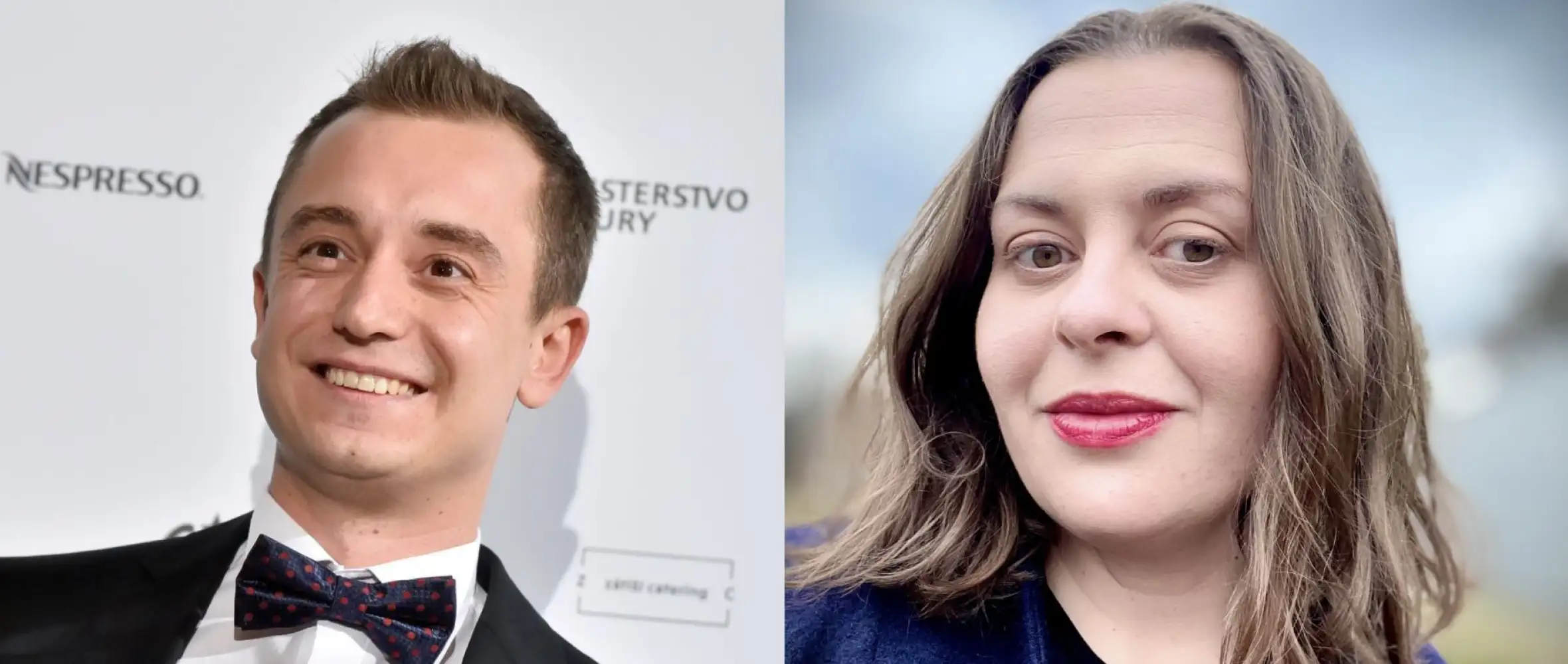
Michal Blaško: Meteoric rise on small and big screen
Emerging talent Michal Blaško entered the domestic audiovisual industry with no layover between student and professional life, adopting a cutthroat pace. Already as a second-year student of film directing, Blaško was tapped by his lecturer Peter Bebjak, one of the most prolific directors in Czech TV and film, to join him and his crew for hands-on experience on a crime series. The next year, Blaško served as assistant director on Bebjak’s award-winning drama The Line (2017), while continuing to get a handle on the rigors of set work and cutting his directing teeth on TV episodes. Blaško has said he considers Bebjak his mentor and is grateful to the seasoned filmmaker for providing him with his first big break in the industry.
Nevertheless, the young director continued to tend to his own ambitions as well, shooting two short student projects—Before Noon (2013) and The Wall (2014), which he cowrote—before his short Fear (2015), a coproduction with Prague’s FAMU, was chosen for the San Sebastian International Film Festival and then went on to garner a host of awards. Fear displayed Blaško’s nascent style: an intimate story steeped in realistic drama, addressing a perturbing social topic, and usually containing some form of violence.
This combination was foregrounded even more in Blaško’s Atlantis, 2003 (2017), a Slovak-Czech coproduction, which took him all the way to the prestigious Cinéfondation Selection for student films at Cannes. This 30-minute drama about a Ukrainian couple attempting to enter Germany illegally put Blaško on the international map as one of the most promising talents in the region. The fact that he not only directed the movie but also penned the script got him a seat in the spotlight at the Future Frames initiative, which scouts upcoming European talents, and the film has since continued to reap awards, both internationally and domestically alike.
In 2017, the young director finished another student film, The Truck, followed by The March in 2018. Both projects revealed him to be a skilled chronicler of important social topics before they broke into mainstream awareness. Throughout his student years, Blaško continued to bolster his profile on the international stage, including Berlinale Talents, while preparations for his feature-length directing debut, Victim, brought him back to La Croisette in search of support at Cinéfondation’s L´Atelier program, which spotlights unique projects from around the globe, fostering a new generation of filmmakers.
Victim, a Slovak-Czech-German coproduction, follows Irina, a Ukrainian immigrant living in the Czech Republic. After her son ends up in the hospital, he tells Irina and police that a group of Roma carried out the attack. As other people increasingly show solidarity for Irina, her son’s account of how events unfolded starts to fall apart. According to the director, the story captures the current social climate and demonstrates the power of prejudice. The film was shot during the COVID pandemic and took on uncanny relevance after the war in Ukraine broke out. While Blaško’s early works are defined by close shots, he says the scenes in Victim are defined by long takes, citing Cristian Mungiu as an inspiration for the cinematographic approach. The film is in postproduction.
Even as he continued his auteur work, Blaško made sure not to neglect his parallel small-screen career, joining the ambitious television project The Slavs (2021), as one of four directors on the epic fantasy series. While that showwent on to become a local blockbuster, the young director was asked to helm the miniseries Suspicion (2022) under the auspices of the Czech production outfit nutprodukce, whose reputation is built on such quality TV projects as Burning Bush (2013) and Wasteland (2016), both of which have received major attention outside the country.
Penned by Burning Bush and Wasteland scribe Štěpán Hulík, Suspicion, inspired by several true cases, revolves around the power of manipulation, the blurred line between truth and the appearance of truth, and the media’s influence on public opinion, when a nurse is suspected of intentionally killing a patient. The psychological drama with a crime bent has been picked for the 2022 Berlinale Series as the first series from Central and Eastern Europe. After its initial run in the Czech Republic, the series will air on the French-German channel ARTE, which served as coproducer.
Blaško has already finished shooting his share of episodes on the third season of the domestic series Cases of the 1st Department and is now at work on his sophomore feature, Cowgirl, joining forces with Victim screenwriter Jakub Medvecký. He describes Cowgirl as a coming-of-age drama that exposes the generational rift between parents and children against the backdrop of corruption in the agriculture industry. This time out, Blaško’s signature approach of blending an intimate story with a relevant social issue will be wrapped in a European rendering of the modern western. Principal photography is tentatively planned for 2024.
Lucia Kajánková: From script editing to showrunning, a Gen Z sensation and beyond
Scriptwriter and story editor Lucia Kajánková has a different career trajectory under her belt than most filmmakers in the Czech Republic, having majored in philosophy and film studies at Charles University before she went on to screenwriting and dramaturgy at FAMU. While still a student, she took on a job as programmer at the Mezipatra Queer Film Festival, then worked her way up to program director. As her career focus shifted more towards moviemaking, in 2015 she left the position for a programming role in the Queer section at International Film Festival Prague – Febiofest, and she is now employed as a senior lecturer in screenwriting at both FAMU and FAMU International.
Meanwhile, Kajánková also acts as a script consultant and story editor for the Czech Television on projects the public broadcaster is boarding as producer or coproducer. At the same time, she continues to serve as an independent story editor on a variety of projects: most recently, the true-crime bio-pic Mr. and Mrs. Stodola, about a pair of Czech serial killers, and director and scriptwriter Milada Těšitelová’s auteur project Animal, about a young woman who tries so hard to conform to society’s demands that she ends up giving birth to a cat. Kajánková has a long-standing collaboration with the domestic animation studio MAUR film, editing scripts for their in-house projects, including Lucie Sunková’s Suzie in the Garden (2021), which premiered at the 72nd Berlinale, and Czech animation marvel Daria Kashcheeva’s eagerly awaited follow-up to her Oscar-short listed Daughter (2019), Electra.
During Kajánková’s studies at FAMU, she creatively partnered with director Jakub Šmíd (Laputa, Short Cut) on his short student film Non-Swimmers (2011), a summer coming-of-age story, as well as his graduation work, Amanitas (2016), a chamber drama about parents and their offspring. Despite being credited as a screenwriter, Kajánková says she has always loved the production side of things even more.
As she began to feel the gravitational pull towards directing, however, desire and ambition converged in her first short film, Inversion (2021), produced by the Czech company Analog Vision. Kajánková’s debut short is a bittersweet coming-of-age story with a slightly feminist perspective, revolving around the friendship of three adolescent girls and their burgeoning sexuality.
Noticing the flourishing demand for high-quality VOD content and the industry transformation driven by growing competition in online video content, Czech Television opened a call for its very first web-only series. Kajánková submitted her project TBH, a coming-of-age high-school comedy-drama laying out the grievances, issues, joys, and pleasures of Gen Z.
Kicking off dramatically with a high-school shooting incident and touching all the hot-button topics, from ecological anxiety to coming out to bullying, TBH’s 10 short-form episodes deliver an unfiltered probe into the lives of online-addicted young adults. The webseries shares DNA with the similarly oriented works Skins and Skam, but offers a Czech take with international appeal. TBH arrives on the heels of the previous online short-form success of #martyisdead (2019), the first-ever Czech Emmy winner.
Kajánková served as showrunner on the webseries, overseeing the project from the first idea through production, postproduction, and up to the release and promo campaign. In addition to directing all the episodes, Kajánková spearheaded the concept of a writer’s room adapted to local conditions.
While busy with TBH, which along with Suspicion has become a domestic sensation, Kajánková continues work on Porcelina, her feature-length directing debut currently in development. Czech Film Fund supported development of the project early on, under the production of Analog Vision. Sharing more details on the pre-apocalyptic queer road movie set in Central Europe, Kajánková says it will be a political film, surveying the evolution of queer identity while following a pair of twentysomethings searching for their place in the midst of a collapsing world. Porcelina is planned as an international coproduction, with principal photography set for autumn 2023. The director noted that the film will be a black comedy, featuring elements of hyperbole and satire paired with hysteria and absurdity. Producer Michal Kráčmer says they are looking for coproducing partners primarily from Germany, Poland, France, and Slovakia, and an international sales agent.
After the success of TBH and with work advancing on Porcelina, Kajánková says she is now ready to dedicate herself to a full-fledged directing career. She hints she may even venture outside the confines of her own auteur projects, helming films written by others in the near future