24 April 2026
Book adaptations, part two: The contemporary writing powering Czech film and animation
Book adaptations, part two: The contemporary writing powering Czech film and animation

While the history of Czech cinema is typified by the adaptation of canonical literary works set in pivotal moments of the past, the relationship between the page and the screen remains equally vital in the present. In recent decades, Czech and Czech-led productions have continued to draw on novels, short stories, and children’s literature to explore contemporary experience and new modes of storytelling across fiction and animation.
by Martin Kudláč for CZECH FILM / Spring 2026
With the Czech Republic preparing to take center stage as Guest of Honor at the 2026 Frankfurt Book Fair, it’s a perfect time to look beyond the cinematic legacy of the Czech literary canon to the influence on audiovisual production of present-day Czech writing.
Literary adaptations have consistently represented a significant share of Czech-produced fiction and animated feature films: roughly one in five titles in recent decades. While an earlier era saw such internationally celebrated adaptations as Želary and The Painted Bird, both shortlisted for Oscars, the current landscape of Czech writing offers a far broader and more diversified spectrum of sources for screen adaptations, ranging from bestselling novels and autofiction to children’s books, graphic novels, and international literary works.
Animated pages, global screens
The most agile and internationally visible form of literary adaptation in Czech cinema is, uncontestably, animation. Long regarded as the country’s most distinctive cinematic tradition, animation has in recent years become central to the reimagining of literature for global circulation.
A key example of this development is Alois Nebel (2011), directed by Tomáš Luňák, based on the graphic novel trilogy Bílý potok (2003), Hlavní nádraží (2004), and Zlaté hory (2005) by Jaroslav Rudiš and Jaromír 99. Using rotoscoping to translate live-action footage into stark black-and-white animation, the film follows the reclusive railway dispatcher Alois Nebel, who is haunted by memories of the post–World War II expulsion of Germans from the area of Czechoslovakia known as the Sudetenland. Its visual strategy, preserving the graphic novels’ aesthetic while grounding it in physical performance, allows it to operate simultaneously as literary adaptation and formal experiment. Awarded the European Film Award for Best Animated Feature, Alois Nebel was selected for such major international festivals as Venice and Toronto, and secured distribution across key European territories, including Germany, Poland, and France. The film’s success was decisive in establishing Czech animation as capable of addressing adult themes with stylistic precision and historical weight.
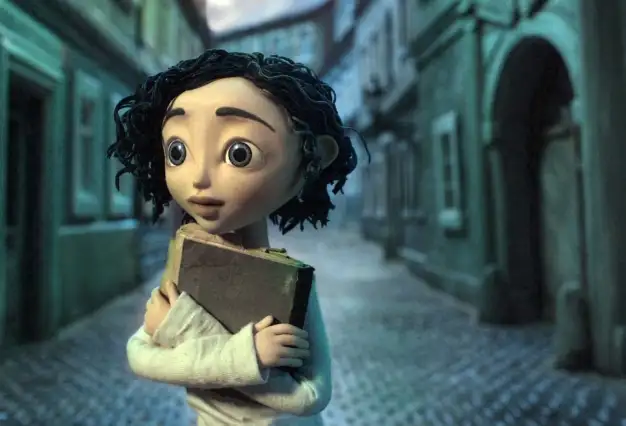
A more recent example is Even Mice Belong in Heaven (2021), directed by Denisa Grimmová and Jan Bubeníček, based on the children’s novel Myši patří do nebe (2006) by Iva Procházková. What begins as a seemingly simple story of a mouse and a fox takes a turn as the animals enter the afterlife and are forced into an unlikely companionship. Combining stop-motion with CGI, the film balances tactile materiality with fluid movement, using its visual language to address questions of mortality and hope. The film moved fluidly between major festivals and a broad international rollout, spanning Europe, Asia, and Australia, with theatrical releases in the critical territories of France, Germany, and Poland, while also scoring a nomination at the European Film Awards.
Michaela Pavlátová’s My Sunny Maad (2021), adapted from journalist Petra Procházková’s novel Frišta (2004), anchors literary adaptation in a concrete geopolitical and cultural context. The film follows Herra, a Czech woman who relocates to Kabul after marrying an Afghan man and gradually comes to terms with the rhythms and constraints of day-to-day life in post-Taliban Afghanistan. Following its introduction in Annecy’s main competition, where it won the Jury Award, My Sunny Maad achieved rare crossover visibility, receiving the César for Best Animated Film and a Golden Globe nomination, and had a sustained international distribution trajectory, including theatrical releases in France, Spain, and Portugal.
Living Large (2024), directed by Kristina Dufková, features a more up-to-date register. An adaptation of Mikaël Ollivier’s best-selling coming-of-age novel La Vie, en gros (2001), about a teenage boy dealing with body image, identity, and social perception, the film skillfully avoids moralization in favor of observational humor. It enjoyed a sustained festival presence, traveling from Annecy to Karlovy Vary to Locarno and a wide range of international showcases before shifting to theatrical and event-based screenings across Europe, North America, and Asia. Excitingly, it also garnered nominations for both Best Animated Feature and Best Film at the 2024 European Film Awards.
Created using a collective model, Tales from the Magic Garden (2025) was jointly directed by David Súkup, Patrik Pašš, Leon Vidmar, and Jean-Claude Rozec, based on stories by the Czech writer, dramatist, and actor Arnošt Goldflam. Conceived as an anthology, the film revolves around a group of children who gather in a garden and share stories, with each segment a self-contained tale displaying a different director’s visual and narrative approach. Moving between grounded, character-based episodes and more overtly fantastical passages, Tales from the Magic Garden uses storytelling itself as its organizing principle rather than a continuous plot.
At the same time, a broader ecosystem of literary-based animation continues to thrive, especially in the family realm. Films like Filip Pošivač’s Tony, Shelly and the Magic Light (based on Jana Šrámková’s Tonda, Slávka a kouzelné světlo, 2023) and Katarína Kerekesová’s The Websters (expanding on the literary universe of her own book series Websterovci, 2017–2023, now in its fourth installment) are examples of the pipeline of children’s literature feeding both standalone features and serial formats.
Literary prestige and festival gravity
In addition to being a driving force of animation, contemporary Czech literary prose continues to serve as a source of inspiration for live-action cinema, with internationally recognized writing brought from the page to the screen in formally rigorous, festival-oriented works. An early benchmark for this was Želary (2003), directed by Ondřej Trojan based on the 2001 book of interconnected short stories by Květa Legátova. The film’s Academy Award nomination demonstrated how literary material could bring Czech cinema into the international spotlight.
Václav Marhoul’s The Painted Bird (2019), adapted from Jerzy Kosiński’s controversial novel of the same name from 1965, represents the most uncompromising expression of this approach. Shot in stark black-and-white and structured as a sequence of episodic encounters, the film follows a young boy drifting through a war-torn landscape marked by violence and moral disintegration. The dialogue is minimal, the imagery deliberately confrontational, and the pacing austere. Following its competition premiere in Venice, the work traveled to major festivals, including Toronto, London, and Tokyo, before securing circulation across Europe, North America, and Asia. The Painted Bird’s selection as the Czech Republic’s Academy Awards submission confirmed its global art-cinema reach.
In the Silver Bear–winning Spoor (2017)—directed by Agnieszka Holland based on the novel Prowadź swój pług przez kości umarłych (2009) by Polish Nobel laureate Olga Tokarczuk—literary adaptation reaches across national boundaries. Set in a remote border region, the story follows an eccentric older woman investigating a series of killings targeting local hunters, gradually shifting from crime narrative to environmental allegory. Genre conventions are introduced only to be unsettled, as the film morphs into moral and philosophical inquiry.
Tomáš Klein’s A Sensitive Person (2023), adapted from the novel Citlivý člověk (2017) by Jáchym Topol, one of the defining voices of post-1989 Czech literature, returns the focus to present-day Czech experience. The film follows a nomadic family on their chaotic journey through a decaying, near-dystopian landscape, viewed chiefly through the perspective of the unspeaking son. Klein condenses Topol’s sprawling, hallucinatory prose into an episodic structure that blends social realism with surreal undertones, resulting in a bleak, darkly ironic portrait of a society characterized by instability and moral fatigue.
The Glass Room (2019), directed by Julius Ševčík based on Simon Mawer’s historical novel of the same name (2009), employs a more classical narrative structure while maintaining a distinctly international orientation. Centered on a modernist house in Brno inspired by the Villa Tugendhat, the story traces the lives of the house’s inhabitants through a succession of political regimes, with the building functioning as a spatial and temporal anchor linking private lives to historical upheavals. The movie’s international tenor is reinforced not only by the English-language source but also by the cosmopolitan cast, starring Carice van Houten, Claes Bang, and Alexandra Borbély alongside Czech and Slovak actors.
In the same vein we also find The Hastrman (2018), directed by Ondřej Havelka based on the Miloš Urban novel Hastrman (2001), which transforms a Gothic literary source into a stylized environmental fable, and Jan Švankmajer’s Insect (2018), drawing on the Karel and Josef Čapek play Ze života hmyzu (1921) to extend the Czech tradition of bringing surrealist writing from the page to the screen.
Social nerves and everyday fractures
While the prestige adaptations described here position Czech cinema in an international art-film framework, a parallel current instead turns inward, registering the emotional and social textures of post-socialist reality. These more domestically centered films—drawing on present-day novels, testimonial writing, and journalism—shift the focus from symbolic universality to the lived experience of individuals, marked by disillusionment, fragility, and unresolved historical echoes.
National Street (2019), directed by Štěpán Altrichter based on Jaroslav Rudiš’s novel Národní třída (2013), exemplifies this shift. Rudiš, one of today’s most widely translated Czech authors, offers a story legible to audiences beyond the domestic market. The film centers on Vandam, a volatile Prague loner who mythologizes his role in the events of 1989, constructing a personal narrative of heroism that masks the reality of his stagnation and resentment. Altrichter preserves the novel’s abrasive humor while tightening its focus into a character study of post-communist masculinity, where public history is reduced to a private script of grievance.
With Her Drunken Diary (2024), directed by Dan Svátek, we see adaptation move into testimonial territory. Based on the confessional book Zápisník alkoholičky by Michaela Duffková (2022), the film tracks the erosion of a woman’s relationships, routines, and sense of self due to her addiction. It was a box-office hit domestically, selling over 550,000 tickets and grossing approximately EUR 3.9 million, making it one of the most successful Czech titles of the year.
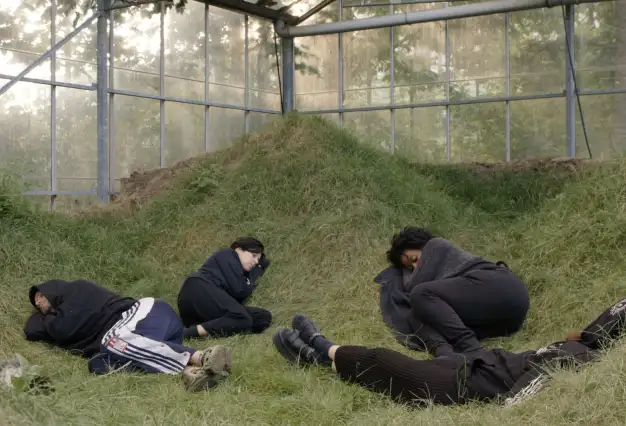
Year of the Widow (2024), directed by Veronika Lišková, is another true-life story, in this case adapted from Zuzana Pokorná’s series of articles “Rok vdovy,” published in the weekly Respekt in 2014 and 2016, documenting the first year after the sudden death of her husband. The film follows Petra, an interpreter in her forties, as she navigates bereavement alongside the ongoing demands of single parenthood, legal red tape, and the pressures of a passive-aggressive mother-in-law and a teenage daugher processing grief in her own detached way.
Popular pages and enduring traditions
Apart from literary adaptations being a major source of socially oriented drama and films ripe for the festival circuit, they remain a reliable go-to for box-office success, particularly when it comes to comedies, family films, and fairy tales. Here we see close ties between film and the domestic publishing market, with books by bestselling authors often serving as ready-made cinematic material with proven audience reach. The writing of Michal Viewegh, for instance, has proven to be a prime source for adaptation, with film versions of his novels regularly following shortly after they appear in print, while post-pandemic, Patrik Hartl has taken this model one step further, directing adaptations of his own commercially successful books with strong box-office results.
Jiří Vejdělek’s The Last Aristocrat (2019), and the sequel, The Aristocrats (2024)—based on Evžen Boček’s best-selling novels Poslední aristokratka (2012) and Aristokratka ve varu (2013)—illustrate this phenomenon. Centered on an aristocratic family returning from exile to manage a deteriorating castle, the films build their humor on the friction between inherited status and contemporary economic reality. The first installment attracted over 500,000 moviegoers in the Czech Republic, and the sequel drew over 300,000, confirming the appeal of popular writing brought to the silver screen.
Fairy-tale adaptations operate in a different yet no less reliable realm when it comes to popularity, drawing on canonical texts that remain part of the national culture due to inclusion in school curriculums and repeated broadcasts on TV. Princess Goldenhair (2025), directed by Jan Těšitel based on the fairy tale “Zlatovláska”—one of hundreds collected by folklorist Karel Jaromír Erben in České pohádky beginning in 1844—revisits an archetypal story of transformation and reward, updated with contemporary production design. Proud Princess (2024), directed by David Lisý and Radek Beran, is another familiar story translated into animation, with its pacing and visual language adjusted for younger audiences.