15 January 2026
Berlinale 2026: Inside broken systems
Berlinale 2026: Inside broken systems

The Berlinale has long been one of the key international reference points for Czech cinema, with Czech films and coproductions consistently appearing across its various platforms. At the 76th edition, the Czech presence will be varied, ranging from the Generation, Panorama, and Forum sections to Berlinale Classics, showcasing contemporary animation, hybrid documentary, sociopolitical drama, and the ongoing international interest in Czech film heritage.
by Martin Kudláč for CZECH FILM / Spring 2026
Representing the Czechs at the 76th edition of the Berlin International Film Festival (February 12–22, 2026) will be Andrea Szelesová’s animated short, Eeny, Meeny, Miny, Moe!, in Generation Kplus; Pepa Lubojacki’s documentary, If Pigeons Turned to Gold, in Forum; Iranian filmmaker Mahnaz Mohammadi’s feature film Roya, a Czech minority coproduction, in Panorama; plus a presentation of Věra Chytilová’s PanelStory, in Berlinale Classics, and the miniseries Monyová, showcased in the Berlinale Series Market Selects at the European Film Market.
Sun-crowned otherness
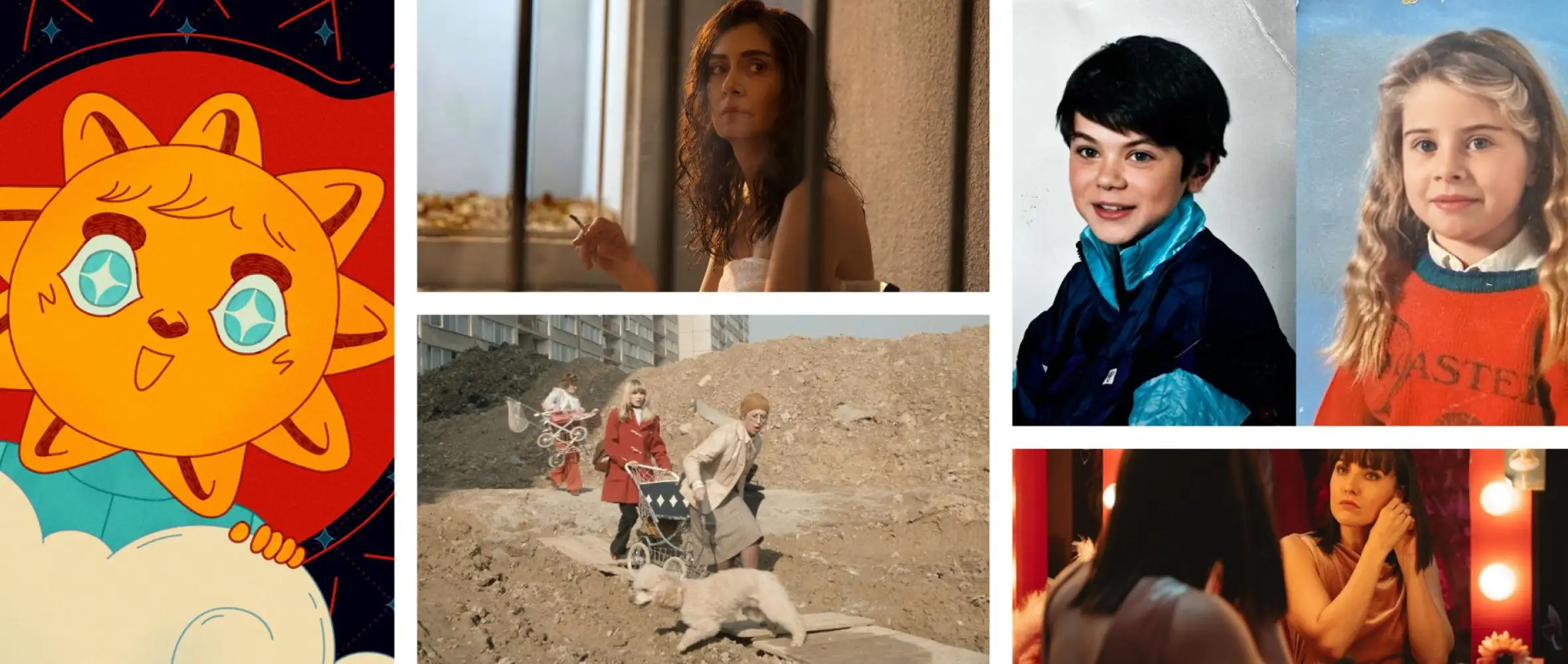
Czech animation returns to Berlinale with Szelesová’s Eeny, Meeny, Miny, Moe!, selected for the Generation Kplus Shorts Competition, distinguished by its commitment to formally adventurous cinema for children and adults alike. The film unfolds as a myth-inspired coming-of-age fable set in a playground among the clouds, where the children of Greek gods and monsters gather to frolic. The story’s protagonist, Yios, inherits a radiant sun-crown from his father, Helios, but cannot control its volatile energy. His emotional intensity manifests as dangerous solar flares, which turns his enthusiasm into a threat, marking him as an outsider. When a prank sends Yios falling to Earth, the story shifts from exclusion to encounter, reframing difference not as a defect but as a force to be understood and channeled.
The selection of Eeny, Meeny, Miny, Moe! for Berlinale solidifies Pure Shore’s reputation as an emerging Czech producer of auteur-driven shorts with sustained international circulation. This project marks a reunion of producer Kristína Husová and Szelesová following Sisters (2021), the director’s Annecy-selected allegorical parable of dependency and emancipation. Where Sisters distilled psychological tension into stark symbolism, Eeny, Meeny, Miny, Moe! targets a younger audience (6–9), opting for humor, empathy, and a clear moral arc on the topic of self-regulation and belonging.
Visually inspired by ancient mythology, Minoan frescoes, and decorated ceramics, the world of Szelesová’s film is populated with playful hybrids, animal bodies, monster silhouettes, and vase-headed children, with difference omnipresent but not always tolerated. Rendered in 2D hand-drawn animation and accessible without dialogue, the film embeds the director’s personal experience of emotional overflow into an imaginative system that makes inner states legible without recourse to adult psychological language. Eeny, Meeny, Miny, Moe! is coproduced by Czech Cinepoint and Slovak ansze, with backing from the Czech Audiovisual Fund, Creative Europe MEDIA, the Slovak Audiovisual Fund, FILMTALENT ZLÍN, and the Czech Horizon Grant by PPF Foundation. The French sales company Miyu Distribution is steering the project’s international rollout.
Hybrid docu-essay about loving those you can’t save
The Berlinale’s Forum, curated by Arsenal as the festival’s laboratory for socio-aesthetic inquiry, will host Pepa Lubojacki’s feature-length documentary debut, If Pigeons Turned to Gold, a Czech-Slovak coproduction that epitomizes the section’s preference for films defined by their stance toward the medium.
Lubojacki constructs their film as an intimate, time-lapse, first-person chronicle of addiction and family inheritance, following their brother and two cousins as their shared childhood fractures into radically divergent adult lives. The picture operates as a mosaic, oscillating between observational street-level footage and an essayistic layer of diary voiceover and therapy-derived audio. The filmmaker positions themself as a mediator between competing realities: care and self-preservation, closeness and withdrawal.
This embedded authorship is reinforced by a dual-image strategy: high-end camera footage mapping time, place, and seasonal change with compositional patience, and mobile-phone cinematography collapsing distance to allow intimacy without the fiction of invisibility. Archival family photographs, reanimated through AI, extend this hybrid logic into memory itself, allowing childhood figures to speak with adult voices. Combined with footage shot on phone, a strain of dark humor, and the deliberately DIY texture of material shot by the filmmaker themself, who also appears on-screen, these strategies give the film a punk sensibility that is unapologetically provocative.
Less a substance abuse documentary than a film about the relational economics of survival, If Pigeons Turned to Gold interrogates the limits of help when the filmmaker is related to their subjects. The project is produced by the Czech outfit CLAW films (Wanda Kaprálová and Klára Mamojková) and coproduced with Slovakian Guča films, FAMU, and Czech Television, with support from the Czech Audiovisual Fund, Eurimages, the Prague Audiovisual Fund, and the Slovak Audiovisual Fund.
The prison that remains
In Panorama, Berlinale’s most audience-facing section and a traditional testing ground for politically resonant cinema, the Czechs are represented by Roya, the latest feature by Iranian filmmaker Mahnaz Mohammadi, produced as a German–Czech–Luxembourgian–Iranian coproduction, with Czech minority involvement via the production outfit Europe Media Nest.
Mohammadi’s film tells the story of Roya, an Iranian teacher imprisoned for her political beliefs, who is faced with a difficult choice: make a forced public confession on TV, or remain confined to her 5-square-meter cell.
Roya foregrounds inner states over political exposition. The experience of imprisonment, physical and psychological, permeates the film’s rhythm, producing a sense of dislocation that mirrors the protagonist’s fractured self-trust. In doing so, Mohammadi continues the direction established in her documentaries and her fiction feature debut, Son-Mother: an insistence on centering women’s subjectivity in systems designed to silence them, without reducing that subjectivity to symbol or slogan. The film is produced by Farzad Pak of PakFilm (Germany) with Kaveh Farnam of Europe Media Nest (Czech Republic) and AMOUR FOU from Luxembourg, in association with NDR, BR, SWR, ARD Degeto, and with support from MOIN Filmförderung Hamburg Schleswig-Holstein, Medienboard Berlin-Brandenburg, and the Film Fund Luxembourg. The Paris-based sales agent Totem Films is handling international rights.
Concrete utopia, human fallout
This year’s Berlinale Classics brings Věra Chytilová back to Berlin with PanelStory, or How a Housing Development Is Born (1979), reinforcing the festival’s long-term engagement with Czech film history beyond the canon. If Daisies is often cited as Chytilová’s anarchic feminist manifesto, PanelStory sharpens her gaze into something colder and more prophetic: a social anatomy of “modern housing” constructed faster than the relationships meant to inhabit it.
Set on a newly built housing estate that exists in the gap between promise and functionality, the film transforms urban planning into an ethical stress test. Miscommunication, ego, fatigue, and everyday humiliation proliferate in an environment designed for collective life but structurally hostile to it. PanelStory turns the Czechoslovak New Wave’s critical eye away from the 1960s, when it was born, to the normalization era of the 1970s.
Chytilová’s depiction of the city as a bodily, psychological experience anticipates later European traditions of social satire and ensemble urban cinema, while the film’s abrasive sound design, episodic structure, and restless camera render the “unfinished city” a permanent condition.
Abuse behind the facade
The Czech presence at Berlinale 2026 also extends into the festival’s industry strand, European Film Market, where the six-part miniseries Monyová will be presented in the Berlinale Series Market Selects program. Produced as a Oneplay Original by Film & Roll, the series arrives in Berlin fresh off of winning the Primetime Killer Award for Best Central and Eastern European TV Series at the 2025 Serial Killer festival in Brno.
Rejecting true-crime conventions, Monyová reframes the life and death of bestselling Czech author Simona Monyová as a psychological drama examining the dynamics of domestic violence. Led by creative producer Klára Follová and director Zuzana Kirchnerová, the series favors subjectivity over procedure, captivating the viewer with emotional insight rather than retrospective explanation.
Kirchnerová, whose feature-length fiction debut, Caravan, premiered in Cannes’ Un Certain Regard in 2025, imposes a controlled cinematic arc on the relationship between Monyová and her abuser: an initially polished, almost romantic surface that gradually tightens into psychological confinement. Anchored by Tereza Ramba’s performance in the lead role, the series balances cohesion with tonal modulation across episodes. By foregrounding mechanisms over events, it turns a nationally known story into a universally intelligible anatomy of power and intimacy, exposing how abuse can thrive behind the carefully maintained facade of a seemingly successful life.