13 January 2026
Monyová and the anatomy of domestic abuse
Monyová and the anatomy of domestic abuse

Selected for the Berlinale Series Market Selects, the six-part miniseries Monyová revisits the life and tragic death of bestselling Czech novelist Simona Monyová. Neither bio-pic nor reconstruction, but a psychological drama examining domestic violence from within, the series shifts the focus from perpetrator to process, exploring how abuse takes shape, why it often remains invisible, and how public success, wealth, and confidence can coexist with private vulnerability to manipulation and coercion.
by Martin Kudláč for CZECH FILM / Spring 2026
A true story, not true crime
From the outset, Monyová distances itself from the conventions that dominate contemporary true-crime storytelling. There is no investigative framework, no procedural suspense, and no narrative fixation on the perpetrator. Rather than operating within a crime-driven narrative logic, the series employs a subjective perspective to follow the internal dynamics of an abusive relationship, its gradual escalation, emotional contradictions, and cycles of affection, control, and fear.
Monyová is a six-part miniseries based on the life of Simona Monyová, one of the most commercially successful Czech writers of her generation, from 1997 to the time of her murder in 2011. Known for her popular romantic novels, Monyová built a strong bond with her readership through stories written with humor, irony, and emotional directness. Publicly, she cultivated the image of a confident, self-made woman and author, while privately she inhabited a far different reality.
At the height of her success, Monyová divorced her first husband, with whom she had two young sons, to pursue a romantic relationship that she believed would be transformative. This longing for “true love” led her into a second marriage that at first appeared fulfilling, but eventually proved to be deeply harmful. Her second husband is depicted in the series as narcissistic and manipulative, exercising ever-greater psychological and emotional control over the writer.
Despite her public recognition, financial independence, and social status, Monyová became trapped in an abusive relationship. The series makes it clear that her success and wealth neither protected her nor made it any easier for her to walk away from the marriage. Though she eventually managed to separate from her second husband, her life ended tragically when he stabbed her to death.
Rather than reducing her to a case study or a cautionary example, the series presents Monyová as a complex individual shaped by ambition and an uncompromising belief that having a fulfilling career, family, love, and personal autonomy all at once was both possible and deserved.
Creative producer Klára Follová (TV Nova) said of the project’s origins, “When I realized her story had never been properly told, I was truly shocked. Not in a tabloid way, but in a cultural sense. It felt absolutely necessary to do, because it’s such a fundamental and urgent topic.”
For Follová, the importance of Monyová’s story lay not in the notoriety of the crime, but in what it reveals about the persistence of domestic violence across social and economic classes. “It’s a story about toxic relationships,” she said, “about how something like this can happen to a woman who was successful, wealthy, and seemingly had everything. The question everyone asks—Why didn’t she leave?—is exactly the wrong place to start. It’s not that simple.”
This understanding of Follová’s shaped the series both in terms of dramaturgy and ethics. Development extended over more than two years and was marked by an exceptionally cautious and reflective process. First and foremost, she wasn’t going to go ahead without the consent of Monyová’s family. “That was absolutely crucial,” Follová said. “If her sons had said they didn’t want the story told, we would have stopped immediately.”
Rather than insisting on a predetermined vision, Follová invited several directors to propose their own approach to the material, without guidance or restrictions. What ultimately convinced her to go with Zuzana Kirchnerová was the director’s commitment to telling the story from Monyová’s perspective and returning narrative agency to her. “She didn’t see it as a crime story at all,” said Follová. “She was interested in Simona as a woman, a writer, a personality, and giving her back her voice.”
Besides her female perspective, Kirchnerová brought to the project a promising professional trajectory. Her feature fiction debut, Caravan, premiered in Un Certain Regard at the 2025 Cannes Film Festival, becoming the first Czech film selected for the section in more than three decades. Her proposal for Monyová, combining a visually attractive surface with an uncompromising psychological focus, aligned closely with Follová’s core intention: to explore the dynamics of abuse from the inside rather than reconstruct events from the outside.
The dynamics of domestic violence
The narrative architecture of Monyová was shaped by a deliberate refusal of linear biography or forensic reconstruction. For head writer Barbora Námerová (Filthy, Nightsiren), who also served as series creator alongside Follová and Marta Fenclová, the challenge was to build a perspective that felt emotionally truthful yet without claiming factual authority.
“We were never interested in saying: this is exactly how it happened,” Námerová said. “That would be neither honest nor responsible.” Instead, the writing team focused on constructing a subjective viewpoint anchored in the protagonist’s inner life: her perceptions, doubts, humor, and gradual loss of certainty.
The series was developed through a writers’ room, still a relatively uncommon model in the Czech television context. Drawing on Námerová’s experience with international development programs, the team, with writers Ivana Sujová and Jakub Haubert, embraced a collaborative process allowing for multiple perspectives to inform the material. “I realized how supportive it can be for a series to have several voices involved,” she said, “especially when dealing with something as complex and sensitive as abuse.”
Research formed a substantial part of the writing process. The team worked with archival material, personal testimonies from people close to Monyová, and, crucially, her own literary work. Her novels, diaries, and public texts provided insight not only into events, but tone, rhythm, and worldview. “We kept asking ourselves how Simona herself might have wanted her story to be told,” Námerová said. That question became a guiding principle.
As a result, Monyová refuses to define its protagonist solely through violence. She is presented as a multifaceted figure: a prolific writer with a sharp sense of humor, a public personality, a mother, and a friend. “It was essential for us not to speak about her only as a victim,” Námerová said. “She had a large circle of people who loved her, and that had to be part of the story.”
One of the series’ distinctive storytelling devices is its incorporation of Monyová’s literary voice. Passages inspired by her writing appear as internal monologues or imagined sequences, blurring the boundary between lived experience and creative expression.
Tonally, the early episodes are deliberately light, even playful. This is not a contradiction, but a structural choice. “The beginning [of relationships] is almost always beautiful,” said Námerová. “The partner seems perfect, and the people around you don’t see anything wrong either, except maybe there’s just a bit too much love.” The gradual transition from affection to control unfolds slowly, almost imperceptibly, mirroring the cyclical nature of abusive relationships and aligning the viewer’s emotional experience with that of the protagonist.
Informed by consultations with experts and survivors, the series avoids simplistic moral binaries. “Demonization doesn’t help anyone,” said Námerová. “It doesn’t explain how these dynamics actually work.”
Illusion of love
For Kirchnerová, Monyová was never a crime story. Her interest lay in the paradox at the heart of the protagonist: visible strength combined with inner fragility. “What fascinated me was how strong and at the same time vulnerable she was,” the director said. “She was successful, a public figure, a mother, and yet these things were happening to her.” From the outset, the creative team agreed on one principle: Monyová would not be framed as a stereotypical victim. “We didn’t want to define her through suffering,” Kirchnerová said. “She was anything but powerless.”
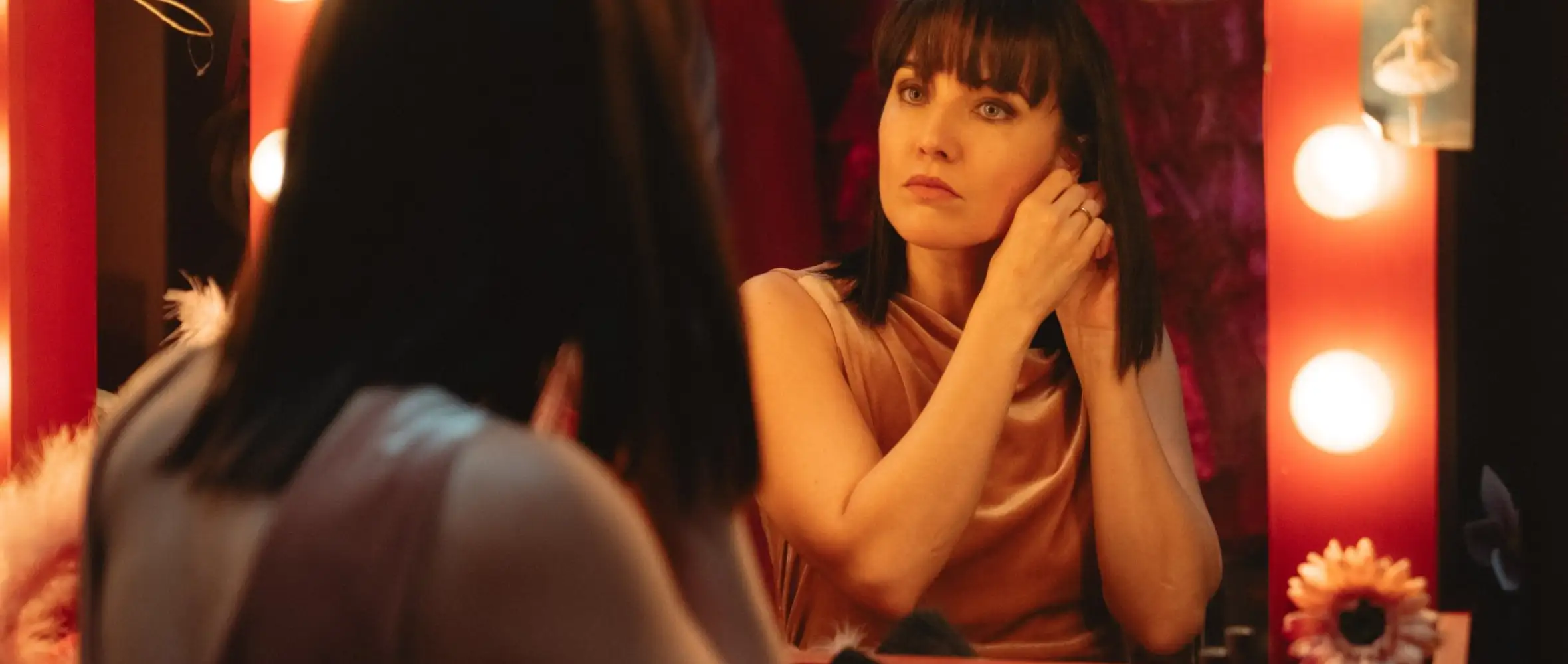
This perspective shaped the series’ visual and tonal language. Rather than adopting a raw or documentary aesthetic, Kirchnerová opted for a stylized, almost romantic surface. Drawing on the popular romantic fiction Monyová herself wrote, the early episodes are marked by warmth, saturated colors, and visual softness. “She wrote romantic novels for women,” the director said. “So I wanted the series to reflect that world, and then gradually undermine it.”
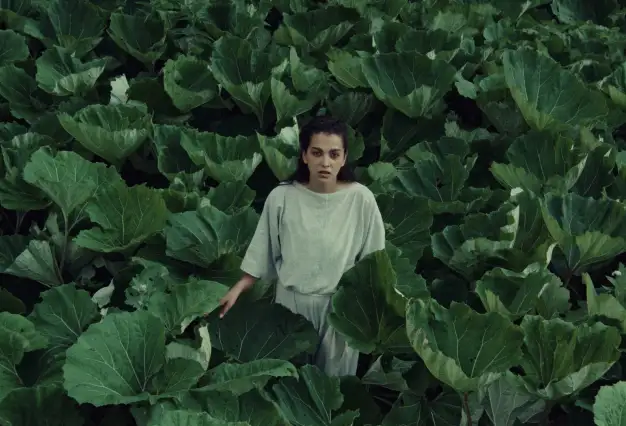
As the relationship with her soon-to-be second husband begins, the series adopts a visually attractive, almost pop and kitsch aesthetic. This is a conscious directorial choice. Kirchnerová explained that the early episodes were designed to reflect the intoxicating phase often described by those involved as “true love,” a period marked by idealization and emotional intensity, employing saturated colors, soft lighting, and a heightened visual polish. However, as the relationship deteriorates over the course of the episodes, the visual language shifts accordingly. The color palette darkens, the compositions tighten, and the camera movements are constrained to emphasize the relationship’s psychological constraints.
Humor, drawn directly from Monyová’s own ironic, sometimes even abrasive tone, plays a structural role early on in the series, reinforcing the illusion of lightness and control, before receding into a denser, more oppressive atmosphere. “The humor isn’t decorative,” said Kirchnerová. “It was part of how she survived.”
Central to this approach is Tereza Ramba (Owners, Her Drunken Diary) in the lead role of Simona Monyová. Kirchnerová sought an actress who embodied both credibility and resilience, someone the audience could believe as a bestselling author and public figure without slipping into victimhood. “We needed someone with inner strength, intelligence, and emotional openness,” the director said. Ramba’s performance anchors the series’ subjective perspective; she is present in almost every scene, creating an unusually intimate proximity between character and viewer.
Ramba is joined by Kryštof Hádek (The Snake Brothers) as Monyová’s first husband and Igor Orozovič (Dogs, Lovers and Other Troubles) as her second spouse.
Kirchnerová also took a proactive approach to staging intimacy and violence. Rather than relying solely on standard protocols, she developed detailed written explanations of every erotic and violent scene in advance, and shared them with the cast as per their contracts. As she said, “If you want to film these moments responsibly, you have to be able to speak about them openly and precisely.”
Selected for the Berlinale Series Market, Monyová has attracted international attention not only for its subject matter, but for its formal clarity and restraint. While Monyová may not be widely known as an author outside the Czech Republic and Slovakia, the series is built on behavioral patterns that are not at all unique to those societies. “You don’t need to know who she was,” Kirchnerová concluded. “What matters is the experience. And that is universal.”
Produced as a Oneplay Original by Klára Follová of Oneplay, , with production services provided by Veronika Finková’s Film & Roll.. Shot in accordance with sustainable filming and production principles, and supported by the Czech Audiovisual Fund´s Production Incentive programme and the South Moravian Film Fund, the completed series joins the platform’s slate of projects inspired by real-life stories, personalities, and historical events, with a premiere planned for 2026.