01 January 2026
Redefining the texture of the ordinary
Albert Hospodářský and Adam Koloman Rybanský
Redefining the texture of the ordinary
Albert Hospodářský and Adam Koloman Rybanský

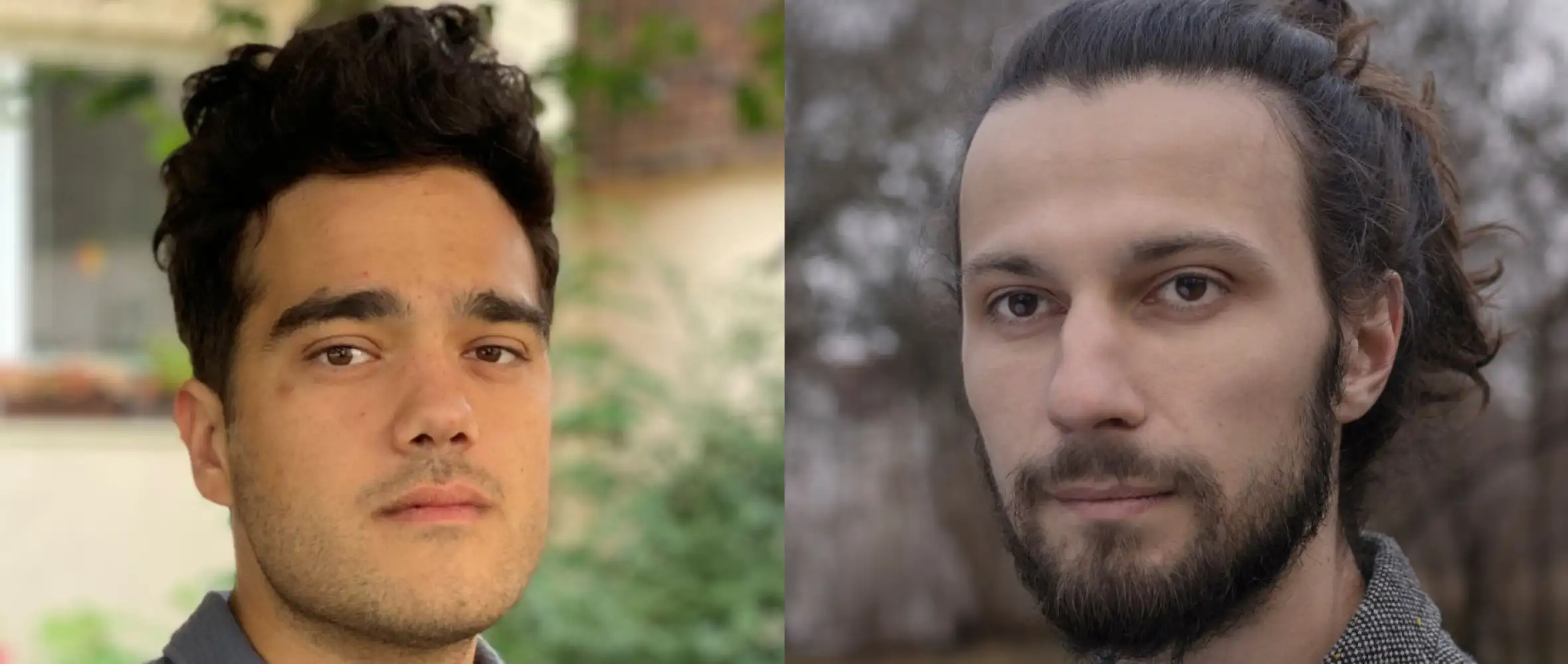
Filmmakers Albert Hospodářský and Adam Koloman Rybanský represent two parallel strands in the newest generation of Czech cinema, both from the same post-FAMU landscape but diverging in trajectory. They share a beginning in observational mode, Hospodářský through documentary and hybrid experimentation, Rybanský through behavioral studies anchored in provincial environments, and each has transitioned to fiction with a focus on the fine-grained dynamics that shape everyday life. Yet while Hospodářský moved away from sensitive documentation in the direction of psychologically oriented, formally structured fiction, Rybanský has refined an approach rooted in absurdist realism and controlled visual minimalism.
by Martin Kudláč for CZECH FILM / Spring 2026
Adam Koloman Rybanský: The absurdity of everyday virtue
Emerging filmmaker Adam Koloman Rybanský belongs to the burgeoning cohort of Czech filmmakers whose work examines the micromechanics of social behavior, local identity, and everyday misunderstanding. His films combine absurdist realism with a restrained visual language, often using static compositions, long takes, and nonprofessional actors to expose the subtle tensions within tight-knit communities.
A graduate of FAMU’s Directing Department, Rybanský first drew wider attention with the student shorts Friendly Sport Meeting (2017) and Home Sleep Home (2018). Both were nominated for the Magnesia Award for Best Student Film and introduced many of the thematic and stylistic features he continues to develop: a focus on provincial social structures, the friction between private belief and collective behavior, and the understated humor that emerges from local routines and rituals.
His debut feature, Somewhere Over the Chemtrails (2022), produced as his FAMU graduation film, encapsulated these concerns. Centred on a group of rural volunteer firefighters who misinterpret a minor traffic incident as a terrorist attack, the film examines how fear and misinformation shape community dynamics. Premiering in the Panorama section at the Berlinale, the work was noted for its calibrated use of nonactors, minimal camera movement, and careful control of tone, a blend of deadpan comedy, understated tension, and social observation.
Rybanský’s second feature, Bohemian Paradise, further develops this interest in the contradictions of everyday life through a more intimate narrative framework rooted in his signature combination of understated humor, behavioral observation, and formalistically restrained storytelling. The project, which continues his collaboration with key creative partners from his debut, maintains his method of working with nonactors in smaller roles and his preference for static wide frames, minimal camera movement, and naturalistic performances.
The film centers on a middle-age married couple, Milan and Týna, whose planned seaside holiday collapses due to financial constraints. Their improvised alternative, a budget camping trip in the Czech region of Bohemian Paradise, becomes the catalyst for the slow unraveling of their relationship. A minor argument escalates when Milan abruptly leaves the campsite, gets drunk, and fails to return. His disappearance, initially driven by frustration, turns into a multiday ordeal as he becomes lost in the surrounding woods. Týna’s mood shifts from irritated to concerned as the separation forces them both to confront their long-standing dissatisfaction with the relationship and their emotional distance from each other.
Working again with producers Eva Váchová and Pavel Vácha of the Prague-based production company Bratři, cinematographer Matěj Piňos and his returning composer Adam Bláha, Rybanský maintains creative continuity with his first feature. While Bohemian Paradise remains grounded in the naturalistic, visual language typical of his earlier work, this time out he emphasizes structured scenes and calibrated tonal modulation, albeit with more camera movement than in his debut. The cast is led by Tomáš Jeřábek (Snake Gas) and Magdaléna Borová (Girl America), supported by an ensemble that mixes professional actors with nonactors in smaller parts, maintaining the director’s preference for authentic local textures.
The film uses the physical environment of Bohemian Paradise—the poetic name for a region of the Czech Republic boasting an abundance of forests, trails, and rock formations—as both a literal setting and a narrative structure. Milan’s inability to find his way back becomes an externalization of his emotional drift, while Týna’s waiting forces her to reassess the gap between routine coexistence and genuine partnership. While the premise leans on exaggeration, Rybanský treats the material without sentimentality, focusing instead on the quiet, recognizable frustrations that accumulate in long-term relationships.
The director notes that, unlike Somewhere Over the Chemtrails, which developed intuitively from an organic production process, Bohemian Paradise is built on a more defined narrative logic and clearer emotional architecture, without the overt political undercurrent that marked his debut. The script is designed to balance situational humor with the psychological realism of a couple unable to articulate their needs until confronted by crisis. Dry humor and understated situational irony are used as narrative tools rather than comedic set pieces.
While Rybanský has not yet announced his next feature project, he has indicated his upcoming work will remain grounded in small-scale environments and interpersonal dynamics, while exploring new variations of his established observational and behavioral approach. As he moves beyond his second feature, the director aims to continue refining his method of controlled, character-focused storytelling, with several concepts in early creative development. This progression suggests sustained engagement with contemporary Czech social realities and a steady expansion of his signature style. Alongside his film work, Rybanský supports himself as a gardener.
Albert Hospodářský: The poetics of disquiet
Albert Hospodářský belongs to the youngest generation of Czech directors. With a background in documentary film and a growing reputation in fiction, he navigates the terrain between inner consciousness and external reality, revealing how the personal and the social intertwine in the lives of young people adrift in a fragmented world.
Hospodářský studied at Prague’s FAMU, in the Department of Documentary Filmmaking. His early shorts demonstrated a fascination with the psychology of youth, poetic identity, and the limits of representation. Nekyia: Inner Portrait of the Poet Hradecky (2019), selected for the Czech Joy competition at the Ji.hlava IDFF, exemplifies this early phase. Through the hybrid form of poetic documentary and staged reconstruction, Hospodářský explored the creative crisis of a poet as an allegory for the struggle between expression and silence, reason and dream.
Hospodářský dropped out of FAMU before completing his bachelor’s degree in order to focus on his feature-length debut, Brutal Heat (2023), which marked his transition to fiction storytelling. The lo-fi, genre-defying coming-of-age story premiered in the Proxima competition at the Karlovy Vary IFF, where it received the Jury’s Special Mention. It then went on to win the main prize for Best Czech Feature Film at the Finale Plzeň Film Festival, confirming Hospodářský as one of the country’s premier emerging talents. After its theatrical release in Czech and Slovak cinemas, Brutal Heat landed on HBO Central Europe.
The film follows a young man wandering through an oppressively hot landscape in the midst of a mysterious solar flare. Beneath its apocalyptic surface lies a delicate study of alienation, generational anxiety, and the loss of emotional compass in an overheated, overstimulated world. Hospodářský merges observational realism with mythic abstraction, using natural light, long takes, and elliptical dialogue to evoke both physical exhaustion and metaphysical dread. The result is a hypnotic, slow-burning parable about the limits of human resilience and the search for meaning in the ruins of connection.
Hospodářský is currently developing his sophomore feature, Restless, a fiction project marking a shift toward a more structured and formalistically defined approach. The film follows Lola, a young woman whose increasing emotional instability strains her marriage and disrupts the quiet rural life she shares with her husband, Sláva. Seeking an outlet for her escalating restlessness, she seizes an unexpected chance to escape to a remote Mediterranean island, forcing Sláva to accompany her.
What begins as an attempt to recover a sense of purpose becomes a descent into psychological volatility, culminating in a near-fatal self-inflicted snakebite. Designed with a precise visual and narrative framework, in contrast to the intuitive, observational style of Brutal Heat, Restless aims to guide the viewer through the fluctuating emotional states at its center. The film is conceived as a tightly constructed study of disorientation, longing, and the search for stability.
The director has indicated that he intends to continue working with nonactors in smaller roles and to maintain an authentic sense of social and visual environment. Key collaborators from Brutal Heat—producer Ondřej Lukeš, cinematographer Tomáš Uhlík, and composer Jan Tomáš—remain the core creative team.
Restless is planned as a three-country European coproduction with a significantly stronger financing architecture than Hospodářský’s debut. The feature was in development for nearly two and a half years, and took part in Midpoint Feature Launch, where it benefited from script and production mentoring and its first international exposure. During the Thessaloniki module, producer Ondřej Lukeš strengthened ties with future partners. A Greek coproducer, Alaska Films, is already confirmed.
The teaser has already been completed for the film, shot in the summer and starring Simona Lewandowská in her first major role. The producer envisions autumn 2027 or spring 2028 as the optimal shooting window, timed to align with the screenplay’s seasonal requirements, partner schedules, and the expected coproduction structure, placing the film on track for a 2028–29 festival premiere and release cycle, provided funding is confirmed as anticipated.
Besides Restless, Hospodářský is currently writing a pilot for an original series. The project is at an early script stage without formal backing yet. The choice of serial form is partly driven by the material itself and partly by pragmatic considerations: new funding schemes for series and a more direct route to audiences than local theatrical distribution.
Alongside his auteur-driven work, Hospodářský occasionally collaborates on other projects, having worked as an assistant director on Bohdan Karásek’s upcoming feature, The Champion, and the short film Things Left Unspoken by Jan Jindřich Karásek. Hospodářský earns his living not from film work but primarily as a professional interior painter, preferring to leave cinema as a space for developing his own long-term auteur projects.